New Free Bible Study: What Does Justice and Righteousness Look Like in Everyday Life?
What does justice look like in a family? In a workplace? In a neighborhood? How should it shape the way we use our resources, treat others, fulfill our responsibilities, and respond to people in need?
Those questions led to the creation of a new free Bible study.
Justice and righteousness are central themes throughout Scripture. Yet for many Christians, these words can still feel frustratingly vague.
What exactly do justice and righteousness look like in practice?
Many of us can recognize injustice when we see it. We may have a general sense that God cares about justice and that He calls His people to live righteously. But translating those broad ideas into everyday decisions and habits can be more difficult.
What does justice look like in a family? In a workplace? In a neighborhood? How should it shape the way we use our resources, treat others, fulfill our responsibilities, and respond to people in need? Those questions led to the creation of a new free Bible study.
The study focuses on Job chapters 29 and 31, where Job reflects on the kind of life he lived before his suffering began. In these chapters, Job provides something that is surprisingly rare in Scripture: a detailed picture of what justice and righteousness looked like in the daily life of a specific person.
Job describes how he treated the vulnerable, how he used his position and influence, how he conducted himself in matters of integrity, and how he understood his responsibilities toward others. Rather than discussing justice and righteousness as abstract concepts, Job presents a practical example of what they looked like in action.
This study walks through those passages carefully and invites readers to reflect on their own lives along the way. The goal is not merely to learn about justice and righteousness, but to consider how they can take shape in real and visible ways today.
The study is designed for both individual and group use, with reflection and discussion questions that encourage thoughtful engagement with Scripture. It is available as a free download and is free to share with friends, family members, churches, Bible studies, and small groups.
Download the free study guide here.
Justice Topics in the Bible
The Bible has a lot to say about justice and themes connected to justice: righteousness, the poor, injustice. There are over two thousand verses about justice and poverty. Justice and righteousness are an essential, key part of the Biblical story. If we want to produce the real fruit of justice in our lives, then we need to plant God’s word about justice.
This is meant to be a resource to you to continue to explore justice in Scripture. It is not comprehensive- but it should help you start.
Justice and Righteousness are what:
God loves: Ps. 11:7, 33:5, 37:28, 45:7, 99:4, 146:8; Prov. 15:9; Isa. 61:8; Heb. 1:9
God delights in: Jer. 9:23-24
God expected His chosen people to do: Gen. 18:19, Deut. 16:20, Prov. 21:3, Isa. 56:1, Mic. 6:8, Amos 5:24, Jer. 7:5-7
God expects His leaders to do: Deut. 16:18, 2 Sam. 8:15, 1 Kings 10:9; Ps. 72; Jer. 22:3, 15-16
Jesus will do: Ps. 72, Isa. 11:1-5, Jer. 23:5-6, 33:15-16, Matt 12:20, Luke 4:18-19
Will be permanent when the Holy Spirit comes: Isa. 32: 15-18
Justice and Righteousness are foundational to:
God’s reign: Ps. 89:14, 97:2, 98; Acts 17:31; 1 Peter 2:23; Rev 19:11
God’s chosen people: Gen. 18:19
Jesus’ kingdom and reign: Isa. 9:7, 16:5, 42:1-4; Ps. 72; Rom. 14:17
Justice in Jesus’ life and teachings:
Jesus gives us victorious justice: Matt 12:20
Jesus announces Himself as the anointed one who will proclaim good news to the poor, free the captive and oppressed, and give sight to the blind: Luke 4:18-19
Jesus rejected racism against Samaritans: Jn. 4:1-42
Jesus doesn’t say that money itself is evil, but warns against greed, storing treasure on earth instead of heaven, and serving money instead of God: Matt 6:19-20, 6:24, 19:23; Luke 12:15, 16:13; Mark 7:21-22, 8:36
Jesus touched the Lepers-who were considered untouchable in His day- to heal them: Matt 8:1-3, Luke 17:11-19, Mark 1:40-44
Jesus invited women to learn spiritual teaching from Him, at a time when women weren’t allowed to be taught religious subjects: Luke 10:38-42
The longest recorded conversation that Jesus has in the gospels is with a Samaritan woman, at a time when men wouldn’t talk to any woman publicly: John 4:1-42
Women weren’t allowed to be a legal witness at the time, but they were the first witness to Jesus’ resurrection: John 20:11-18
Jesus called tax collectors, who were participating in corrupt, unjust system, to leave it and follow Him: Matt. 9:9, Luke 19:1-10
Jesus risked His reputation to hang out with the outcasts of His day: Matt 9:9-13, Luke 5:29-32
Jesus called children to come to Him, and valued their perspective at at time when children held a low status in society: Luke 18:15-17, Matt 18:1-7
In the Sermon on the Mount, Jesus lays out how His followers should live, including their social lives and how respond to oppression: Matt. 5-7
Jesus uses the example of stopping to help a victim of injustice is an example of loving your neighbor: Luke 10:25-37
Jesus affirms that workers deserve the wage they were promised: Matt. 20:1-16
Jesus promises that those who feed the hungry, water to the thirsty, clothes the naked, welcome the stranger, and visit the imprisoned are doing those things for Him: Matt. 25:31-46
The poor are made in the image of God and how people respond to them matters to Him:
Rich and poor are all made by God: Prov. 22:2, Job 34:19
If you insult the poor, you insult God: Prov. 17:5
If you oppress the poor, you insult God Prov. 14:31
If you are generous to the poor, you are generous toward God: Prov. 19:17
What you do for the ‘least of these’ is like doing to Jesus: Matt. 25:35-40
What God does for the poor, widows orphans, and immigrants, the most powerless and vulnerable groups in Israel:
God gives them justice: Deut. 10:18
God protects and rescues them: Deut. 26:5-9, 1 Sam. 2:8, Ps. 12:5, 14:6,
God rescues the oppressed when they cry out: Isa. 19:20
God rescues the poor and oppressed from those who exploit them: Ps. 35:10
God doesn’t abandon the physical needs of the poor: Isa. 41:17
God provides for the needy: Ps. 68:10
God protects immigrants and helps widows and orphans: Ps. 146:9
When God reigns, defending them is central to how He uses His power: Ps. 82
Prophets, God’s mouthpieces, call out Israel when they are oppressing them: Eze. 22:7, Mal. 3:5
Prophets condemn oppressing orphans and widows: Eze. 22:7, Zech. 7:10
God acts like a lawyer for the poor and will take vengeance those that hurt the poor: Prov. 22:22-23
God is the help and deliverer of the poor and needy: Ps 40:17, 70:5
Business and economic laws protecting the poor and vulnerable in Israel:
Every third year, a tithe of all the nation’s crops went to the priests, orphans, immigrants, and widows: Deut. 26:12
Everyone who grew food participated in feeding the hungry through by leaving the corners of their fields available for gleaning: Lev. 23:22
The price of food sold to the poor couldn’t be marked up: Lev. 25:35-37
No interest could be charged on loans to the poor: Exo. 22:25
The poor could buy back their land if they lost it: Lev. 25:8-34
Debts were forgiven every 7 years: Deut. 15:1
For loans to widows, their cloaks couldn’t be taken as collateral at all: Deut. 24:17
For loans to the poor, you couldn’t keep their cloak as collateral overnight because they needed it for cover: Deut 24:12-13
Leading with Justice and Righteousness:
Unjust king Jehoiakim is contrasted with the righteous and just king, Josiah: Jer. 22:13-17
Nehemiah confronts injustice and oppression of the poor: Neh. 5:1-13
Leaders need wisdom to do justice and righteousness: 1 Kin. 3:7-17, 28; Prov. 8:13-16
Kings are told not to drink because they might forget the rights of the poor : Prov. 31:4-7
Kings- one of the most important and most heard people in the land- must use their voice to speak up for the voiceless: Prov. 31:8-9
King’s throne is established with righteousness: Prov. 16:12
The righteous are concerned about the rights of the poor: Prov. 29:7
Righteous people in authority brings joy to everyone: Prov. 29:2
Kings bring stability to the land by justice: Prov. 29:4
Job description of the ideal king in Israel, and a Messianic prophecy, includes: Ps. 72
Leaders who use their power for violence are called out: Eze. 22:6
Giving justice to the poor leads to the longevity of kings: Prov. 29:14
Those who make unjust and oppressive laws that keep the poor from getting justice are condemned Isa. 10:1-4
The prophet calls out those that became rich through stealing and keeping justice from the orphan and oppressed Jer. 5:26-28
Immigrants and refugees:
God loves the immigrant to Israel: Deut. 10:18
Israel is commanded to love the immigrants among them because God does: Deut. 10:18-19
Israel is commanded to love the immigrants around them as they love themselves: Lev. 19:34
The material needs of immigrants were part of Israel’s law: Lev. 19:9-10
Isreal is commanded to not oppress immigrants or deprive them from justice: Exo. 23:9 , Mal. 3:5
Prophets condemn exploiting immigrants: Eze. 22:7
Jesus and His family fled as refugees in Egypt to save Jesus’ life from violence: Matt. 2:13-23
Paying workers is essential:
Israel was commanded to pay their workers everyday, because if they didn’t, the workers would will cry out to God: Deut. 24:15
Israel was commanded to not hold worker’s wages overnight: Lev. 19:13
Workers deserve the wage they were promised: Matt. 20:1-16
Prophets call out those who don’t pay their workers: Mal 3:5
When workers in aren’t paid by follow members of the church, their cries are heard by God and He has a strong, personal response: Jam. 5:1-6
Hurting the poor is taken seriously by God:
Withholding justice from the immigrant, orphan and widow brings curses: Deut. 27:19
Hurting the poor insults God Himself: Prov. 14:31, 17:5
Israel is condemned for exploiting the poor: Amos 2:6-8
Women are called out for oppressing the poor Amos 4:1
An example of an unrighteous and unjust life includes oppressing the poor and needy: Eze. 18:12
Withholding help from those in need is a sign that God’s love isn’t in a person: 1 John 3:17
When workers in aren’t paid by follow members of the church, their cries are heard by God and He has a strong, personal response: Jam. 5:1-6
Help for the needy in the early church:
The only time in the Bible when there was no needy among God’s people is in the first generation of the church: Acts 4:34
The early church re-structures a food program for widows after conflict between the Greek and the Hebrew widows: Acts 6:1-4
Paul sets guidelines for which widows should receive support, helping Timothy solve a logistical problem at His church: 1 Tim. 5:3-16
Pure religion is expressed in helping widows and orphans: Jam. 1:27
Paul praises the sacrificial giving of the believers in Macedonia to other needy churches: 2 Cor. 9
Faith is practically expressed by giving food and clothes to needy brothers and sisters: Jam. 2:15-17
Paul commands believers to contribute to the needy in the Christian community: Rom. 12:13
Christians are commanded to share with the needy: Heb 13:16
The rich sharing with the needy is an demonstration of God’s love 1 Jn. 3:16-17
How we are shown to respond to those doing injustice in the New Testament:
Jesus called those participating in an unjust system to follow Him : Matt. 9:9, Luke 19:1-10
Paul, who persecuted and helped kill Christians, is transformed in Christ, and becomes an apostle: Acts 8:1-3, 9:1-31
Our war isn’t against flesh and blood, but against the spiritual forces behind evil: Eph. 6:12
Thieves should stop stealing and become contributing members of a community: Eph. 4:28
Praying for and honoring leadership:
Israel was commanded to never curse their rulers: Exo. 22:28
Paul says to pray for political leaders so you can lead peaceful lives: 1 Tim. 2:1-3
Give taxes to your nation and honor to those in authority: Rom 13:1-7
UPDATE: This is now available as an episode on the God Loves Justice Podcast. You can listen on Spotify and Apple Podcast.

Joy-filled, Peace-filled Kingdom Justice
When choosing a career, I faced a dilemma. I wanted to do was justice work, but that life seemed to come with baggage: hopeless from dealing with injustice all the time, frustration at the world never changing, premature wrinkles. I thought I had to choose between a life filled with peace, joy, fun, sleep- OR justice. I couldn’t have it all.

“If you’re not living justice with peace and joy, then you aren’t living in the Kingdom”
When choosing a career, I faced a dilemma. I wanted to do was justice work, but that life seemed to come with baggage: hopeless from dealing with injustice all the time, constant frustration at the world for never changing, anger because of feeling misunderstood, and premature wrinkles. I thought I had to choose between a life filled with peace, joy, fun, sleep- OR justice. I couldn’t have it all.
Thankfully, I’ve since met many wonderful Christians doing kick-butt justice work while simultaneously living a thriving life. Their model follows Jesus’ own life. It made me re-consider whether embracing a life of doing justice had to be filled with all that other package.
One day, God, doing what He likes to do, challenged me with this verse:
“for the kingdom of God is not eating and drinking, but righteousness [dikaiosune] and peace and joy in the Holy Spirit (Romans 14:17 NASB)”
In Greek, the word that’s translated into English as righteousness, dikaiosune, also needs the concept of justice to understand it (for more explanation of this translation, see here).
When I read that verse, I sensed God speak to my hear, “If you’re not living justice with peace and joy, then you aren’t living in the Kingdom.” Ouch. That was definitely not my life at that moment. I seemed to be able to do justice really well, or peace and joy really well, but not all of them as the same time.
Justice in the Kingdom of God is full of peace and joy. My life can (and should) be filled with peace and joy as I do justice.
But I can’t do it without God. This kind of justice is found in one place: in the Holy Spirit. Apart from the presence of the Holy Spirit, this kind of justice is impossible. Inviting the Holy Spirit to be the source of the Kingdom justice we do, we can live in joy and peace during the process.
The justice and righteousness that you do should lead to peace and joy in the world. Peace and joy should be a distinguishing mark of Christian justice and righteousness work.
UPDATE: This is now available as an episode on the God Loves Justice Podcast. You can listen on Spotify and Apple Podcast.

Justice: Hiding in Translation
When I first started studying what the Bible said about justice topics, I thought I knew exactly how to find them: search for the word “justice.” But there’s a problem with looking for justice in the New Testament. If you type “justice” into a Bible word search engine, it doesn’t appear much. “Justice” appears only 11 times in the ESV translation, 9 times in the NASB, and 8 times in the NKJV. For those translations, “justice” shows up more in the book of Isaiah—around three times more, in fact—than in the entire New Testament.

This post is part of the series “New Testament Justice.”
When I first started studying what the Bible said about justice topics, I thought I knew exactly how to find them: search for the word “justice.” But there’s a problem with looking for justice in the New Testament. If you type “justice” into a Bible word search engine, it doesn’t appear much. “Justice” appears only 11 times in the ESV translation,[i] 9 times in the NASB, [ii] and 8 times in the NKJV.[iii] For those translations, “justice” shows up more in the book of Isaiah—around three times more, in fact—than in the entire New Testament.[iv]
In the few instances where the word “justice” appears, the word primarily refers to legal justice, which feels distant from the Hebrew shalom-centered ideas of justice in the Old Testament. Verses like “Mercy triumphs over judgment [krisis]” (James 2:13b), or “Judge [krino] not, that you be not judged” (Matthew 7:1) make it seem like justice and judgment are opposite of mercy and, therefore, don’t belong in the New Testament.
It’s hard to see that the New Testament values justice when it seems almost silent on the subject. Given this near-silence, I used to wonder if justice, especially “social justice” topics, simply didn’t belong in a New Testament paradigm. Maybe God meant us to leave behind anything that looked like humanity’s old ways of relationship, including the Old Testament’s model of justice.
Thankfully, I kept reading and discovered just how much justice is part of the New Testament—I just had to learn to see it. My simple Bible word search couldn’t show it.
HIDING IN TRANSLATION
Translating the Greek words for justice into English gives us yet a pretty big set of challenges. The Greek word most often translated “justice” in our English New Testament is krisis and is related to “judgment,” krima. The root is krino, meaning to sift and separate, like when a person evaluates something and makes a decision.[v] That’s a good picture of God as Judge—the compassionate, all-knowing one who sifts and makes judgments. That’s His job, not ours, because He sees things we can’t see like people’s hearts. The definitions of krisis line up with our English definitions: legal decision, condemnation, the authority to judge, punishment, or judgment.[vi] Krima has similar legal definitions.
But these meanings miss the more holistic dimensions of justice you see in the Old Testament. Those dimensions do show up in the New Testament, however, through the Greek word dikaiosune. Dik-stem words are common in the New Testament, showing up around 300 times. The concept of dikaiosune is captured by two English words—righteousness and justice—yet is almost always translated as one of the two: “righteousness.”[vii] Likewise, other dik-stem words, like dikaios and dikaioo, are translated as “right-” words—righteous, righteousness, right, etc.—instead of “just-” words.[viii]
At the time the New Testament was written, however, dikaiosune was not just used to mean “righteousness.”[ix] In fact, translators of classical Greek literature usually did the opposite when translating dikaiosune into English, opting for “justice” instead of “righteousness.”[x] In classical Greek, dikaiosune meant “well-ordering,” and it was an important word for understanding justice and government at the time. Plato’s Republic, written almost four hundred years before Jesus’ birth, was among the most influential books on the ideal structure of government of the day and was much concerned with “justice”—dikaiosune. [xi] To Plato, justice was important for understanding the human soul as well as the state.[xii] It was more than a personal quality; it was particularly demonstrated in relationships.[xiii] A “just” or “righteous” person fulfilled their proper role in civilized society.[xiv]
Not every language has the same challenge that we English-speakers have. Romance languages like Spanish and French don’t have a word for “righteousness,” so dikaiosune is translated almost entirely as “justice.” But if you look for the English word “justice” in the New Testament, it isn’t in there much. If you look for “righteousness,” you’ll see it all over.
This translation problem helps explain why the New Testament seems almost silent on justice. When English-speakers like me read the Bible, it seems like righteousness is what we are supposed to pursue, not justice. And because righteousness in our world is connected to private, personal morality, it can seem like the highest goal of Christian life is to be clustered inside of church buildings, never doing wrong, instead of doing right in the wider world.
UPDATE: This is now available as an episode on the God Loves Justice Podcast. You can listen on Spotify and Apple Podcast.
[i] Matthew 12:18, 12:20, 23:23; Luke 11:42, 18:3, 18:5, 18:7, 18:8; Acts 8:33, 28:4; Hebrews 11:33
[ii] Matthew 12:18, 12:20, 23:23; Luke 7:29, 11:42, 18:7, 18:8; Acts 28:4, Col 4:1
[iii] Matthew 12:18, 12:20, 23:23; Luke 11:42, 18:3,; Acts 8:33, 28:4; Romans 9:14
[iv]ESV: Isaiah 1:17, 1:21, 1:23, 1:27, 5:7, 5:16, 9:7, 10:2, 16:3, 16:5, 28:6, 28:17, 30:18, 32:1, 32:16, 33:5, 40:14, 42:1, 42:3, 42:4, 51:4, 56:1, 59:8, 59:9, 59:11, 59:14, 59:15, 61:8 (28 total)
NASB: Isaiah 1:17, 1:21, 1:27, 5:7, 9:7, 10:2, 16:5, 28:6, 28:17, 30:18, 32:16, 33:5, 40:14, 40:27 42:1, 42:3, 42:4, 49:4, 51:4, 56:1, 59:8, 59:9, 59:11, 59:14, 59:15, 61:8 (26 total)
NKJV: Isaiah 1:17, 1:21, 1:27, 5:7, 5:23, 9:7, 10:2, 16:5, 28:6, 28:17, 30:18, 32:1, 32:7, 32:16, 33:5, 40:14, 42:1, 42:3, 42:4, 51:4, 56:1, 58:2, 59:4, 59:8, 59:9, 59:11, 59:14, 59:15, 61:8 (29 total)
[v] Schneider, W. “Judgment.” Vol. 2 of The New International Dictionary of New Testament Theology. Edited by Colin Brown. Grand Rapids, MI: Zondervan, 1986. 362-367.
[vi] Swanson, James A. A Dictionary of Biblical Languages with Semantic Domains: Greek (NT). Oak Harbor, WA: Logos Research Systems, 1997.
[vii] Blomberg, Craig, and Jennifer Foutz Markley. A Handbook of New Testament Exegesis Grand Rapids: Baker Academic, 2010.
[viii] Wolterstorff, Nicholas. Justice: Rights and Wrongs. Princeton: Princeton University Press, 2008.
[ix] Marshall, Christopher D. Beyond Retribution: A New Testament Vision for Justice, Crime, and Punishment. Grand Rapids: William B. Eerdmans Publishing Company, 2001.
[x] Wolterstorff, Justice: Rights and Wrongs.
[xi] Farley, Benjamin Wirt. In Praise of Virtue: An Exploration of the Biblical Virtues in a Christian Context. Grand Rapids: William B. Eerdmans Publishers, 1995.
[xii] Schrenk, Gottlob. “δίκη, δίκαιος, δικαιοσύνη, δικαιόω, δικαίωμα, δικαίωσις, δικαιοκρισία.” Vol. 2 of Theological Dictionary of the New Testament. Edited by Gerhard Kittel, Geoffrey William Bromiley, and Gerhard Friedrich. Grand Rapids, Mich.: Eerdmans, 1964. 174-224.
[xiii] Wolterstorff, Justice: Rights and Wrongs.
[xiv] Schrenk, “δίκη et al.”

Why can't I "see" justice in the New Testament?
I’m starting a new blog series on Justice in the New Testament because I want to get beyond the surface “Is justice in the Bible?” conversations. It seems like because justice is being re-discovered in American Evangelical churches, the only teaching we get is the “Justice 101: Don’t freak out, yes social justice is a Christian thing, too” sermons. When we are only asking whether justice is even in there, we miss out on so much. Specifically, I think Evangelicals are confused about how social justice/justice and righteousness fit into the New Testament.

I’m starting a new blog series on Justice in the New Testament because I want to get beyond the surface “Is justice in the Bible?” conversations. It seems like because justice is being re-discovered in American Evangelical churches, the only teaching we get is the “Justice 101: Don’t freak out, yes social justice is a Christian thing, too” sermons. When we are only asking whether justice is even in there, we miss out on so much. Specifically, I think Evangelicals are confused about how social justice/justice and righteousness fit into the New Testament.
YES, justice is in the Bible, AND we need the Bible to guide us into how to practically do it everyday. We need to go far beyond surface, 101 level sermons. The Bible- Old and New Testaments- gives us revelation, principles, and models for doing justice, all of which makes us more effective in our work and helps our own lives thrive in the process. Doing justice is hard, and the Bible is a massive resource for us.
To start, I want to go through some of what I think are some of the reasons why Western Evangelical Christians have a hard time seeing justice and righteousness/social justice in the New Testament:
Translation challenges. The word “justice” doesn’t appear much in most English translations of the New Testament- often 10 or less times. Unfortunately, this can make it hard to see how we are supposed to do justice while following Jesus when it looks like He hardly ever says the word, along with all the other New Testament writers. This is a result of an issue translating the Greek work dikaosuine into English. It can mean both justice and righteousness, but it’s almost exclusively translated as righteousness. Righteousness in our culture has a meaning that is almost exclusively connected private morality. That can make it seem like sitting around in church buildings not doing drugs, having sex or watching PG-13 movies as the highest expression of a Christ-centered life. Righteousness is right, does right, and makes right- and that kind of righteous influence is needed in all parts of society. This translation challenge will be explained in more detail in a later post.
Historical reasons. In the early 1900’s, many white Protestant churches split over ’social justice or the gospel,’ in large part due to a reaction to the Social Gospel movement. This particular time in history forced the question “Do we choose the gospel or justice?”— but that is a question that the Bible and God never ask. The God who brings us salvation also reigns in justice and righteousness. The ‘gospel OR justice’ legacy continues today. Because of a century of teaching that social justice is anti-Biblical (instead of being taught the biblical foundations of it), many Christians reject social justice out of a genuine desire to follow Christ. Christians can do both justice and the gospel, as many Civil Rights movement leaders modeled. Churches at in the early 1900’s were unfortunately racially segregated. Black churches didn’t experience the same split over the gospel or justice. In the Civil Rights movement, so many powerful leaders were African American faith leader because they didn’t have to choose between ‘justice or the gospel’ in the same way that many white churches did. In that movement, black Christian leaders were the ones initiating social change based on biblical principles. This is an important leadership lesson for the whole church, if we want to see faith leaders championing and sustaining social transformation, we need a Biblical understanding that doesn’t force us to choose ‘justice or the gospel.’ The gospel leads to justice for us individually and propels us to bring justice and righteousness in the world.
Western meanings of justice. Justice has a legal flavor in English, and it can be hard for Western-minded Christians to learn to do justice without laws. The things we often connect to justice, including judgement, condemnation, punishment, don’t fit into our understanding of a God in the New Testament, full of grace and mercy. Jesus didn’t bring a whole new law code with Him. Instead, He brought us a fully restored relationship to God, a new nature, complete freedom, and access to the Holy Spirit. He brought us into a totally new kind of life—a life that flows from within and is guided by a transformed heart. To many with our law-and-order equals justice Western minds, those things Jesus brought seems to not relate to doing justice. When we bring the kingdom of God on earth, and restoration and wholeness come— that is justice. Compassion, mercy, grace, freedom are what our justice should look like in the world. The chapter “Lawless Love” in my book God Loves Justice explores this topic more.
Social translation challenges. Many/most/all of the revolutionary social parts of Jesus’ life and teachings are missed because we are so far removed from the His cultural context. When we read the stories and commands of Jesus, we often miss what the meant in their social context. He talked to, validated, and included women, children, and Samaritans. In Jesus’ time, those actions carried massive implications. The social world excluded people based on age, race and gender, but Jesus includes them as essential, public parts of His ministry. It should be normal for Christians to do the things that are socially revolutionary. People that have lost their value or worth in the sight of the world should find family in the church. Christians should constantly uplift, include, and value the people that human societies push away. He calls us to join an “Upside Down Kingdom,” which should call us to question the traditional social hierarchies in the world, instead of to defend and sustain them. To follow Christ should cause us to do things that look revolutionary to the social order of the world.
There are many other reasons beside these four. These are just four that I want to address to start this series on Justice in the New Testament. Are there any additional ones that you can think of?
UPDATE: This is now available as an episode on the God Loves Justice Podcast. You can listen on Spotify and Apple Podcast.

Justice and Righteousness: Central, Essential and Foundational to the Kingdom of God
When I first started studying what the Bible said about justice topics, I thought I knew exactly how to find them: search for the word “justice.” But there’s a problem with looking for justice in the New Testament. If you type “justice” into a Bible word search engine, it doesn’t appear much. “Justice” appears only 11 times in the ESV translation, 9 times in the NASB, and 8 times in the NKJV.
It’s hard to see that the New Testament values justice when it seems almost silent on the subject.

When I first started studying what the Bible said about justice topics, I thought I knew exactly how to find them: search for the word “justice.” But there’s a problem with looking for justice in the New Testament. If you type “justice” into a Bible word search engine, it doesn’t appear much. “Justice” appears only 11 times in the ESV translation,[i] 9 times in the NASB, [ii] and 8 times in the NKJV.[iii]
It’s hard to see that the New Testament values justice when it seems almost silent on the subject.
In the few instances where the word “justice” appears, the word primarily refers to legal justice, which feels distant from the Hebrew shalom-centered ideas of justice in the Old Testament. Verses like “Mercy triumphs over judgment [krisis]” (James 2:13b), or “Judge [krino] not, that you be not judged” (Matthew 7:1) make it seem like justice and judgment are opposite of mercy and, therefore, don’t belong in the New Testament.
Translation challenge
To understand justice in the New Testament, we have to confront at a challenge we English-speakers have with translating some of the Greek words. The Greek word most often translated “justice” in our English New Testament is krisis and is related to “judgment,” krima. The definitions of krisis line up with our English definitions: legal decision, condemnation, punishment, or judgment.
Those are not exactly things we would associate with Jesus or grace or mercy. And these meanings miss the more holistic dimensions of justice we see in the Old Testament.
Those holistic, restorative dimensions do show up in the New Testament, however, through the Greek word dikaiosune.
Dik-stem words are common in the New Testament, showing up around 300 times. The concept of dikaiosune is captured by two English words—righteousness and justice—yet is almost always translated as one of the two: “righteousness.”
However, at the time the New Testament was written, dikaiosune was not just used to mean “righteousness.” In fact, translators of classical Greek literature usually did the opposite when translating dikaiosune into English, choosing for “justice” instead of “righteousness.” In classical Greek, dikaiosune meant “well-ordering,” and it was an important word for understanding justice and government at the time. Plato’s Republic, written almost four hundred years before Jesus’ birth, was among the most influential books on the ideal structure of government of the day and was much concerned with “justice”—dikaiosune.
Below is an image of a Roman coin with "dikaiosune" stamped on it. If dikaiosune had only private, moral, religious meanings, then why would the Roman government have used it on a their money?
[For all you level 10 nerds (#represent!), here is a short video by Dr. Clint Arnold, Chair of New Testament Studies at Talbot Theological Seminary and President of the Evangelical Theological Society, on translating dikaiosune. You're welcome.]
The picture of a “righteous Christian” life this translation issue creates
This translation issue can distort the images we then develop about what it looks like to live the Kingdom of God on earth. When English-speakers read the Bible, it seems like righteousness is what we are supposed to pursue, not justice. And because righteousness in our world is connected to private, personal morality, it can seem like the highest goal of Christian life is to be clustered inside of church buildings, never doing wrong, instead of doing right in the wider world.
Justice and righteousness: core to the Kingdom
Let’s look at a few verses that dikaiosune shows up and look at what they tell us about the Kingdom of God. For a long time, I got the message that the options were to EITHER pursue justice OR the gospel. The more I’ve studied the Bible, the clearer it has become how wrong that message is. Doing justice/righteousness won’t distract from “more important” kingdom work, they are kingdom priorities. They are central to what the Kingdom is and how we Christians live our lives:
“For the kingdom of God is not eating and drinking but righteousness/justice [dikaiosune] and peace and joy in the Holy Spirit” (Romans 14:17 NASB). Jesus talks about the Kingdom a lot, but He never actually says what the Kingdom is. His audience at the time would have heard about the Kingdom of God, so Jesus didn’t explain it. Because of this, there is only one verse in the whole New Testament that directly says what the Kingdom of God is, and that is this one. Justice and righteousness are the Kingdom.
“But seek first His kingdom and His righteousness/justice [dikaiosune]” (Matthew 6:33a NASB). In the same breath that we are told to seek God’s kingdom, we are told to seek God’s justice and righteousness. If we are heading in the direction of the Kingdom, we are heading in the direction of justice and righteousness. Doing justice and righteousness are extending the reign of God on earth.
“…those who receive the abundance of grace and of the gift of righteousness/justice [dikaiosune] will reign in life through the One, Jesus Christ.” (Romans 5:17b NASB) Justice and righteousness are gifts that enable us to reign in life. The foundation of our call to use our authority on earth to bring heaven is justice and righteousness.
So to know what the Kingdom is, what Jesus tells us to seek, and how we reign in life, we need justice and righteousness. They are central, foundational, and essential to the Kingdom of God.
UPDATE: This is now available as an episode on the God Loves Justice Podcast. You can listen on Spotify and Apple Podcast.
_______________________________________________________________________________
[i] Matthew 12:18, 12:20, 23:23; Luke 11:42, 18:3, 18:5, 18:7, 18:8; Acts 8:33, 28:4; Hebrews 11:33
[ii] Matthew 12:18, 12:20, 23:23; Luke 7:29, 11:42, 18:7, 18:8; Acts 28:4, Col 4:1
[iii] Matthew 12:18, 12:20, 23:23; Luke 11:42, 18:3,; Acts 8:33, 28:4; Romans 9:14

Western-ish-Flavored Views of Justice Versus Hebrew
Part of the challenge of learning about biblical justice is that our Western-ish views of justice are so different from Hebraic views from the time the Bible was originally written in. When an American Christian hears about justice, the images that we think of probably things like police officers, punishment, and courtrooms (and maybe a great TV drama about all those things). Unfortunately, that can make us reject doing justice now because we think of it through our Western-ish lenses. If God were to love our Western-flavored justice, then that would make Him a law-obsessed, punishment-loving judge. That is so far from what we know about God from the New Testament, so therefore we reject doing justice as Christians out of a genuine desire to reflect the Bible. But that is not at all the right image of a justice-loving God, or how we as Christians should do biblical justice.

Part of the challenge of learning about biblical justice is that our Western-ish views of justice are so different from Hebraic views from the time the Bible was originally written in. When an American Christian hears about justice, the images that we think of probably things like police officers, punishment, and courtrooms (and maybe a great TV drama about all those things). Unfortunately, that can make us reject doing justice now because we think of it through our Western-ish lenses. If God were to love our Western-flavored justice, then that would make Him a law-obsessed, punishment-loving judge. That is so far from what we know about God from the New Testament, so therefore we reject doing justice as Christians out of a genuine desire to reflect the Bible. But that is not at all the right image of a justice-loving God, or how we as Christians should do biblical justice.
So how can we change our Western-ish-flavored views of justice to a more biblical view? A helpful place to start is to get an overview of how different the Hebrew views of justice are compared to the Western.
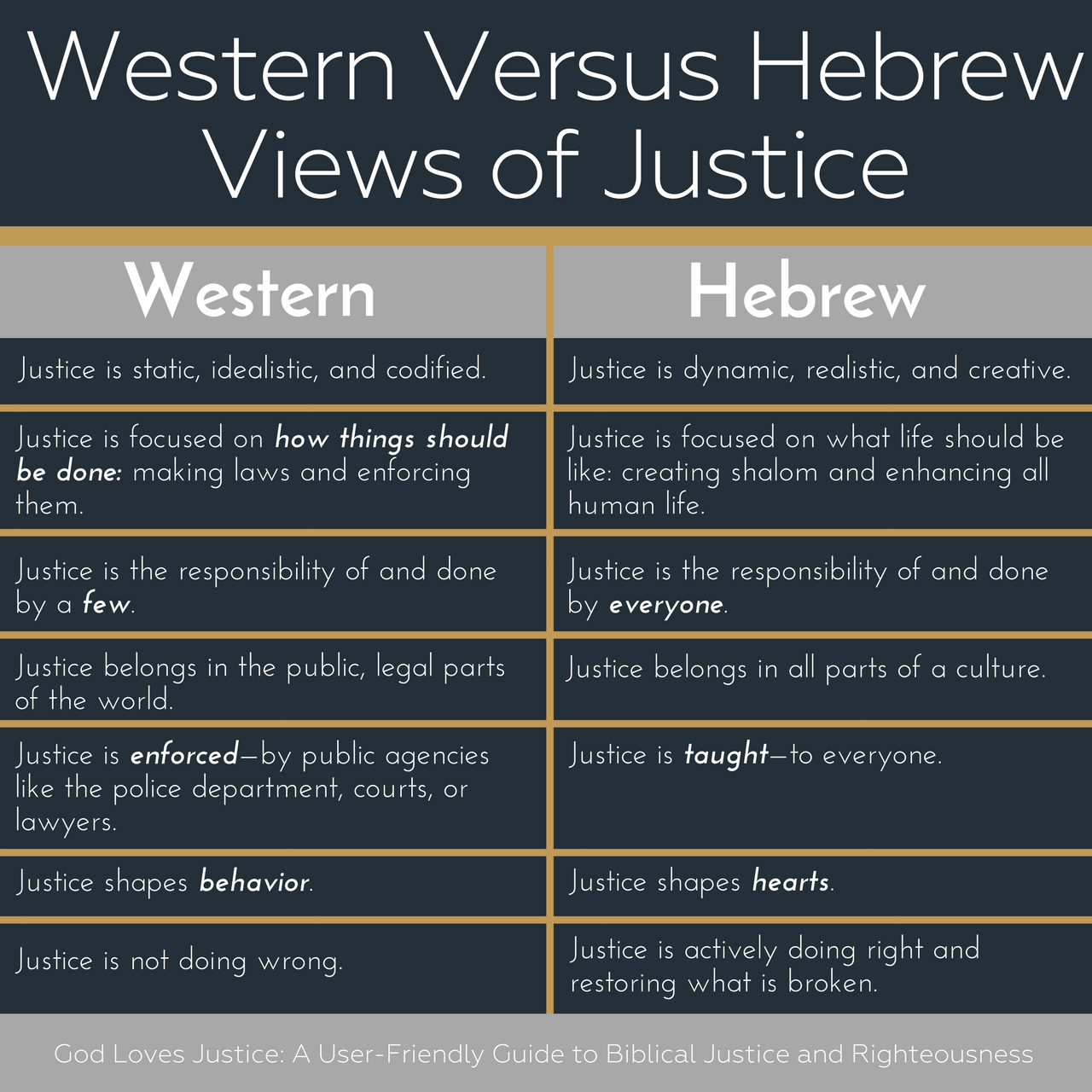
A summary of the ways that the Western-ish and Hebraic views of justice are different
.
Western views of justice are primarily focused on how things should be done—laws, rules, and what should happen when laws are broken. In Hebrew thought, justice is focused on what life should be like.[i] Justice in the Hebrew world was concerned not just with laws, but with enhancing all human life, especially the social world. That meant justice applied to all relationships—between a ruler and his subjects, between the weak members of a community and the strong, and between institutions of the nation of Israel and citizens.
The Hebrew word that sums up “what life should be like” is shalom. That word usually shows up as “peace” in our English Bibles, but the meaning in Hebrew is more than simply the lack of conflict. Shalom comes from a root word that means “to be complete” or “to be sound.”[ii] Shalom is a peace that comes from everything being complete and whole, so there it can be translated also as security, well-being, or prosperity.[iii] The purpose of justice in Hebrew society was to restore and sustain shalom.[iv] In particular, those with the least amount of power needed special protection. This is why the Old Testament contains many reminders that Israel must do justice to the poor, widow, immigrant, and orphan. And “doing justice” meant not only “not doing wrong,” but also actively doing right and restoring what is broken.[v]
Another major difference between justice in the Bible and our modern views of justice is that in our world, justice has to be enforced by institutions like the police force, courts systems, and prisons. This gives rise to the impression that doing justice is the responsibility of only a few people. If something is broken and it’s not our fault, then we commonly assume we don’t have to do anything to fix it. In the biblical world, however, justice was done by everyone and was everyone’s responsibility. Because of that, justice was taught not merely enforced.[vi] People took ownership of the shalom and wholeness of their community; and, if something was wrong, they worked to right it, even if it wasn’t their fault. When you look at the law given by God to Israel, especially in the book of Deuteronomy, you can see how this education looked. The laws are not given line by line in a strict code; they are backed up with teaching and encouragement.[vii] God intended the entire culture of Israel to learn and teach how to do justice in a way that shaped their hearts as well as their behavior.
(And to learn more about how different the biblical and Western views of justice are, check out this blog post.)
UPDATE: This is now available as an episode on the God Loves Justice Podcast. You can listen on Spotify and Apple Podcast.
[i] Schwarzschild, Steven S. “Justice.” Vol. 2 of Encyclopedia Judaica, 2nd Edition. Edited by Fred Skolnik. Jerusalem: The Jerusalem Publishing House/Thomson Gale, 2007. (578-579)
[ii] Carpenter, Eugene E. and Philip W. Comfort. “Peace.” In Holman Treasury of Key Bible Words: 200 Greek and 200 Hebrew Words Defined and Explained. Nashville, TN: Broadman & Holman Publishers, 2000. (135)
[iii] Gesenius, Wilhelm, and Samuel Prideaux Tregelles. Gesenius’ Hebrew and Chaldee Lexicon to the Old Testament Scriptures. Bellingham, WA: Logos Bible Software, 2003. (שׁלוֹם)
[iv] Schneider, W. “Judgment.” Vol. 2 of The New International Dictionary of New Testament Theology. Edited by Colin Brown. Grand Rapids, MI: Zondervan, 1986. (362-367); Mafico, Temba L. “Just, Justice.” Vol. 3 of Anchor Bible Dictionary. Edited by David Noel Freedman et al. New York: Doubleday, 1992. (1127-1128)
[v] Morris, Leon. The Biblical Doctrine of Judgment. Grand Rapids: Eerdmans, 1960.
[vi] Houston, Walter. Contending for Justice: Ideologies and Theologies of Social Justice in the Old Testament. London: T & T Clark, 2006. (107, 131)
[vii] Ibid., 107.

Love Via Socks
I saw him standing on the corner of the narrow downtown San Diego streets from the passenger seat of my friend's enormous white pickup truck. Something about his tired-looking face stood out to me. Immediately, I felt like I needed to go offer him socks and a sandwich. A few Saturdays each month, my friend and I would bring food and socks and hand them out as we hung out with some homeless people known to live in the area.
But the man didn't really look homeless, so I almost talked myself out of it. Wouldn't he be offended if a random stranger offered him a homemade peanut butter and jelly sandwich and generic white socks?

I saw him standing on the corner of the narrow downtown San Diego streets from the passenger seat of my friend's enormous white pickup truck. Something about his tired-looking face stood out to me. Immediately, I felt like I needed to go offer him socks and a sandwich. A few Saturdays each month, my friend and I would bring food and socks and hand them out as we hung out with some homeless people known to live in the area.
But the man didn't really look homeless, so I almost talked myself out of it. Wouldn't he be offended if a random stranger offered him a homemade peanut butter and jelly sandwich and generic white socks?
I assumed he would be gone by the time we got to that street corner. First we had to park and haul bags of food down a five-floor parking garage, Perfect excuse to not do something potentially embarrassing and offensive.
But when my friend and I walked out of that garage ten minutes later, I saw the man was still standing in the exact same spot. There wasn't a way out- I knew we needed to go talk to him. My friend and I crossed the street and walked straight up to him.
"Excuse me. This is random, but do you want socks or a sandwich or a bottle of water?" I asked. His eyes widened and his face looked limp. For a few seconds, he didn't say anything. It was just enough time for me to convince myself that I had just offended a random stranger in the middle of a busy street with the audience of judge-y strangers. I almost started to apologize when his face finally showed what emotion he was feeling- shock.
"What?" He spit out suddenly. "Did you just offer me socks? Are you serious? I just told God that I need socks and that I wasn't leaving this street corner until I got new socks."
My friend and I stood there, sharing his shock. We laughed because we didn't know what to say. This was the first time I'd ever heard anyone say that they prayed for socks. Wow, within minutes, God had answered his request.
He was clearly deeply moved and didn't say much after that. My friend and I chatted with him for a quick minute, and he let us pray for him. He left that street corner with the exact thing he asked God for.
Later, it hit me what the encounter demonstrated. The profound, immense, deep, passionate care that God had for that man was practically expressed through a single pair of Costco men's socks.
All of the "socks and sandwiches" stuff started when I was a college student and read in Isaiah 58 that God wanted me to share my food with the hungry, which I decided to take literally. I cut down on my food budget and whenever I saved an extra $15, enough for the ingredients for 40 sandwiches, I would make up a bunch of peanut butter and jelly, and take them to parts of downtown where the homeless often stayed. Later, I brought socks along after many started telling me that's what they appreciated the most.
It would have been easier with my hectic student schedule to give my money away to a hunger-related cause. But when I prayed about what to do with the money, I felt like I needed to do something that would give personal connection to the hungry that I was sharing "my food" with.
There was so much that I learned through the years I did this. But this one has stuck deeply with me. Something as small as socks can supernaturally communicate the immense care and concern that God has for each of us individually.
Simple gestures tangibly express God's love. While they are so easy to overlook because they seem mundane and unimportant, if we let ourselves be motivated by love, those gestures can have a deep impact. Whenever we share our lives, our food, and ourselves, no matter how small it may seem, we get to participate in demonstrating to the world what a generous and caring Father that God is.

Exciting, Happy, Delightful Justice
Do a quick check. If you got the news that God’s justice was coming, how would you feel? Confused? Scared? Nothing? The emotional response we see in the Bible makes a clear picture: God's justice and righteousness are so awesome that it makes everyone and everything everywhere ecstatic. This is an important lesson for us. Being shaped by God's own heart for justice and righteousness, and getting a biblical understanding for that they are, means that our reaction to justice and righteousness should include excitement, happiness, and delight.

Do a quick check. If you got the news that God’s justice was coming, how would you feel? Confused? Scared? Nothing? The emotional response we see in the Bible makes a clear picture: God's justice and righteousness are so awesome that it makes everyone and everything everywhere ecstatic. This is an important lesson for us. Being shaped by God's own heart for justice and righteousness, and getting a biblical understanding for that they are, means that our reaction to justice and righteousness should include excitement, happiness, and delight.
Justice is exciting! Creation’s response
Let's look at a passage that talks about God coming to judge and rule over the earth:
Say among the nations, “The Lord reigns!
Yes, the world is established; it shall never be moved;
he will judge [saphat] the peoples with equity. (Psalms 96:10 ESV)
The passage then goes on to tell us how exactly creation responds to this news. Pay careful attention to the “for” toward the end to say why creation is so happy:
Let the heavens be glad, and let the earth rejoice;
let the sea roar, and all that fills it;
Let the field exult, and everything in it!
Then shall all the trees of the forest sing for joy
before the Lord, for he comes,
for he comes to judge [saphat] the earth.
He will judge [saphat] the world in righteousness [sedeq],
and the peoples in his faithfulness. (Psalm 96:11-13 ESV)
The heavens are GLAD, the earth REJOICES, the sea ROARS, the fields EXULTS, forest trees SING FOR JOY. Why? For God is coming to judge the earth.
Now, creation is not being sadistic, and rejoicing that God is going to come and destroy everything. God’s righteous justice is life-giving, and it makes His whole creation happy when it comes.
Justice is happy! People’s response
So creation is happy when God comes to judge, but what about people? Let's look at another Psalm to see how people react to God’s mishpat:
Zion hears and is glad, and the daughters of Judah rejoice, because of your judgments [mishpat], O Lord. (Psalm 97:8 ESV, see also Psalm 48:11)
God’s mishpat is something that makes Zion GLAD and the Daughters of Judah REJOICE. . Another Psalm uses similar language:
As your name, O God,
so your praise reaches to the ends of the earth.
Your right hand is filled with righteousness [sedeq].
Let Mount Zion be glad!
Let the daughters of Judah rejoice
because of your judgments [mishpat]! (Psalm 48:10-11 ESV)
“Right hand” is a symbol of power and authority, and it is filled with righteousness. That makes Mount Zion, a symbol for the citizens of Jerusalem, GLAD. Daughters of Judah, a symbol for the people in the cities of Judah, REJOICE because of God’s mishpat.
When God's justice happens, it brings joy:
When justice [mishpat] is done, it is a joy to the righteous [saddiyq] Proverbs 21:15a
God’s justice and righteousness elicits a similar emotional response in people: joy and happiness. What’s something right now that you can naturally get happy and overjoyed about? Good news about a family member? A promotion at work? A new ice cream shop opening on your street? Does it take work for you to feel happy about those things? Probably not. Imagine naturally feeling that way over God’s righteousness and justice.
Justice is delightful! God’s response
We already heard that justice is something that God loves, His own emotions toward justice and righteousness are positive:
“[B]ut let the one who boasts boast about this: that they have the understanding to know me,that I am the Lord, who exercises kindness, justice [misphat] and righteousness [sedeqah] on earth, for in these I delight,”declares the Lord. (Jeremiah 9:23-24 ESV)
God delights in justice. Delights. To know and understand God is to know that He does justice and righteousness. Equally important, God tells us what motivates Him to do what He does: “…in these things I delight.” This is huge. Delight is God’s why behind the justice, righteousness, and steadfast love He practices. It’s not out of frustration or obligation, but delight. God's justice and righteousness are delightful.
How-to guide of reacting to justice
God's justice and righteousness are delightful. They should bring us joy and happiness when we see them done on the earth.
This is a good litmus test to tell whether or not you understand God’s justice. Our modern Western concepts of justice create feelings of fear and shame. Who gets happy when you hear that the government is about to bring a judgment against you? If you can rejoice, sing for joy, roar, be glad, and exult when you hear about God’s righteous justice, then it’s a good sign that your heart has been shaped by God's love for justice and righteousness and that you have the biblical understanding of them.
UPDATE: This is now available as an episode on the God Loves Justice Podcast. You can listen on Spotify and Apple Podcast.
[1] Bratcher, Robert G., and William David Reyburn. A handbook on Psalms. New York: United Bible Societies, 1993.

Resources for Studying the Bible
I grew up hearing some version of: "READ YOUR BIBLE IT'S YOUR CHRISTIAN DUTY" all the time. But I had no idea how to do this "reading" that I was constantly commanded to do. The Bible not like other books, where you could open it up at the beginning and just read it through to end. I tried that once and stopped after Exodus.

I grew up hearing some version of: "READ YOUR BIBLE IT'S YOUR CHRISTIAN DUTY" all the time. But I had no idea how to do this "reading" that I was constantly commanded to do. The Bible not like other books, where you could open it up at the beginning and just read it through to end. I tried that once and stopped after Exodus.
Sometime I wish that Bible came in handbook form, where I could just open to a section about a part of life that I need to understand and where I could find a clear, line-by-line explanation. Instead of that, when you open the Bible, you find a very diverse range of writing styles, voices, moods, stories. To understand those, you have to know a bit about the language and world it was written in. The one law code in there, the Mosaic Law, was made complete by Jesus so you can't just read and do it now (otherwise none of use could have round haircuts, eat bacon, or cook goat by boiling a kid goat in its mother's milk). How do you connect one part to the others? What was the world like when it was written? What parts am I supposed to take literally?
I found that taking the time to study the Bible helped me to read the Bible. Now when I open the Bible to different sections, I know more about how to connect it to other sections, what the culture was like, why the language uses metaphors like it does.
I grew up going to church on Sundays and went to a Christian school, so I've had a good amount of Bible teaching. But even after all those years, there was a lot that I didn't know and needed to learn. It's only been in adulthood that I've really learned to actually study the Bible. It's a process you have to take ownership over. Your pastor shouldn't be in charge of studying the Bible for you.
This is just a simple challenge: Find a way to integrate Bible study into your normal life rhythm of your life. Here are some helpful resources I've found:
- iTunes U app: I'm *obsessed*. You can get free classes from some of best seminary professors. And you can listen during your commutes and evening jogs. These classes were an easy way to learn about challenging subjects like the context of the Greco-Roman World and understanding the Mosaic law. Fuller Theological Seminary, Dallas Theological Seminary, and others have classes up that you can download.
- Free online resources: Lots of websites have free materials on them. Biblehub.com has commentaries that you can search by Bible verse. BlueLetterBible.com/app is great free resource that I use to look up Greek/Hebrew words in a verse. It has a concordance, commentaries, and other good resources.
- Logos Bible Research software/app: This is a pricier, nerdier option, but it you get what you pay for. You can purchase different packages, and it gives you access to lots of commentaries, books, dictionaries, encyclopedias. The search functions make it very easy to use and makes studying go faster. The smartphone app has some good, free resources on it.
- Podcasts: Lots of churches and pastors put out podcasts now, giving you new teaching on a weekly basis. My current favorites are Timothy Keller (practical, interesting, very well researched) NT Wright (provocative, different, makes you think), and RT Kendall (Spirit filled former paster at Westminster chapel with great insight on Scripture- his sermon on forgiveness is life-changing).
- Bible study materials: Most Christian bookstores have Bible study sections. I like ones that go into cultural context and the original Hebrew/Greek of a verse. Beth Moore has some good ones.
- Books: Kind of a duh resource- but there is a reason why books remain so popular. Some recent favorites are:
- Paul's Metaphors: Their Context and Character by David Williams: An easy read and lot of good information. Paul's letters use a lot of illustrations and metaphors from his time, and the book outlines many of them. After I read this book, it made his epistles so much more clear.
- Money, Possessions, and Eternity by Randy Alcorn: My favorite book on the topic of money in the Bible. It's balanced, comprehensive and practical.
- Studies in the Sermon on the Mount by Martyn Lloyd-Jones: A classic resource on the Sermon on the Mount. It's long, but well-organized so it's a good book to read for a while, put down, and come back to as you get time.
- Do We Need the New Testament?: Letting the Old Testament Speak for Itself by John Goldingay: This man is my favorite voice on the Old Testament. This book is a short introductions for Christians that struggle to understand and value the Old Testament. He's also written some wonderful textbooks and commentaries. A lot of his seminary lectures at Fuller through the iTunesU.
- The Prophetic Imagination by Walter Brueggemann: Anything by Brueggemann is worth reading. His perspective and language are totally unique. I've read parts of his textbooks, and even those are wonderful.
- Challenge part 2: Read something from the perspective that you haven't heard from before. People with very different opinions spend their whole lives devoted to studying the same book, I've found that even in theological traditions that I don't 100% agree with, they have interesting insight that helps me understand God more. I'm assuming that y'all are mature enough to know that you can 'eat the meat and spit out the bones.' Try another perspective you've never heard from before, like Catholic, conservative Baptist, Spirit-filled, Latin American liberation theologians, etc.

Scales versus Rivers
A helpful illustration of just how different our Western views of justice are from Biblical justice can be seen in the two of the cultural's symbols: scales versus rivers.
A helpful illustration of just how different our Western views of justice are from Biblical justice can be seen in the two of the cultural's symbols: scales versus rivers.
In the Western world, justice is often symbolized by “Lady Justice,” a blindfolded woman holding a sword and scales. That symbol is from the Roman goddess, Justitia (or Greek goddess Themis) showing that justice is impartial, standard, and orderly. The balances weigh the two sides of a case and determines which is right. The powers that reason and justice has are contained in the sword. Getting justice is a strict and mechanical process, involving zero passion and emotion.
Now, this image isn’t wrong, but we have to remember that our justice comes from God, not "Lady Justice." Contrast that blindfolded, scale-analyzing ideas of justice with an image used by the prophet Amos:
"But let justice roll down like waters And righteousness like an ever-flowing stream” (Amos 5:24 ESV)
Amos gives this message as a response to the cruel injustices Israel was allowing to invade every level of their nation: trampling the poor, crushing the needy (2:7), sexually abusing servant girls (2:7), women manipulating their husbands to hurt the poor (4:1) businesses twisting God’s laws for their selfish profit (8:4-7) Yet, at the same time, the nation thought they were fine because they were still doing all the good "religious" activities they thought God liked (4:4-5, 5:21-23).
In response to this horrific scene, Amos declares that trying to make up for injustice with becoming extra religious is wrong, and not what God actually wanted (5:14-15, 21-23). The nation desperately needed to turn back to God, and receive transformation and healing for their nation from Him. Amos prays that rivers directly from God would come and restore justice and righteousness. That's not a balanced, mechanical, impersonal, unemotional process. Rabbi Abraham Joseph Hescel describes Amos’ river this way:
“A surging movement, a life-bringing substance, a dominant power. A mighty stream, expressive of the vehemence of a never-ending, surging, fighting movement- as if obstacles had to be washed away for justice to be done. Justice is more than an ideal or a norm: justice is charged with the omnipotence of God. What ought to, shall be! … Balancing is possible when the scales are unimpaired, and the judge’s eyes sound. When the eyes are dim and the scales unsure, what is required is a power that will strike and change, heal and restore, like a mighty stream bringing life to a parched land... Righteousness is a vast and mighty stream because God is its unfailing source.” (Abraham Joseph Heschel, "The Prophets")
God’s justice and righteousness are a powerful, never-ending river, a force that moves obstacles to its goal of healing and restoration out of its way. It’s the answer for when our human ways of justice are not capable of fixing sin, evil, and injustice. What happens if injustice is so great that no act of legal justice can correct it? Or legal justice can’t restore the deep damage done? Or when injustice has invaded every part of a nation so no legal system is capable of fixing everything?
Lady Justice gives us Westerners an incomplete image of Biblical justice. A justice that creates laws and enforces them in a calm, impersonal, orderly way is one expression of justice. At times, it’s needed.
But it’s not the only way of justice, and doesn’t get to the heart of God’s own justice, the righting of wrongs, restoring the world back into God’s original intent for how life should be experienced. From the beginning, God’s justice has been transformational[1]—restoring the world back to right again—and covenantal—restoring our relationships with Him and others. [2] Legal can punish the wrong, but it can’t always make it right again. The pain in the victims or destruction in the world because of the impact of sin, that can’t be fixed by legal justice. We need the blind scales of justice. And we also need the rivers of God's justice and righteousness, the power to heal and transform the world, taking out every obstacle blocking its way.
UPDATE: This is now available as an episode on the God Loves Justice Podcast. You can listen on Spotify and Apple Podcast.
[1] Brueggemann, Walter et al. To Act Justly, Love Tenderly, Walk Humbly. An Agenda for Ministers. (New Jersery: Paulist Press, 1986), 6.
[2] Gibbs, J.G. “Just” Pages 1167-1168 in vol. 2 of The International Standard Bible Encyclopedia. Bromley, Geoffrey W., ed. 4 vols. (Grand Rapids, MI: Eerdmans, 1987). Rf. Runesson, Anders. “Judgment” pp 457-466 in Vol. 3 of 5. The New Interpreter's Dictionary of the Bible: I-Ma. Sakenfeld, Katharine Doob, ed. (Nashville, TN: Abingdon, 2008).

God's Grief
A question that stuck with me when I first stared reading about justice in the Bible was: Why does God take justice and injustice so seriously? Is He like a law-obsessed ruler sitting on His far away throne, enjoying throwing lightening bolts at particularly sinful people? That fit the picture I had of Him when I was growing up. But it didn't explain His passion for justice I saw in the Bible, one that seemed profoundly tied to people and relationships.
A question that stuck with me when I first stared reading about justice in the Bible was: Why does God take justice and injustice so seriously? Is He like a law-obsessed ruler sitting on His far away throne, enjoying throwing lightening bolts at particularly sinful people? That fit the picture I had of Him when I was growing up. But it didn't explain His passion for justice I saw in the Bible, one that seemed profoundly tied to people and relationships.
Let’s go back to the beginning, to what I think is the most important part of thinking about justice: God’s own heart.
Within one generation of God making His good Creation, the first murder takes place- Cain killing Abel in a fit. It doesn't take long for humans to really mess everything up. A few generations after that, Noah was born into a world marked with corruption and violence. It didn’t take long to go from one single act of sin to: “the earth was corrupt in God's sight, and the earth was filled with violence [chamas] (Gen 6:6b, ESV).” Now imagine what that must be like for God to experience- He created a perfect world, made man to cultivate His perfect earth, and these humans that He made in His own image were now hurting each other. It says that:
Then the Lord saw that the wickedness of man was great on the earth, and that every intent of the thoughts of his heart was only evil continually. The Lord was sorry that He had made man on the earth, and He was grieved in His heart. (Gen 6:5-6, ESV)
What’s in man’s hearts? Unending evil thoughts. And what happened in God’s heart as a response? Grief.
This is the only emotion that’s attributed to God in the whole book of Genesis- and it is pain.[1]
God doesn't say that He's angry at humanity for their sin, or frustrated that He's going to have to have to develop a new plan to redeem it all. Instead, He's grieved over the impact that sin has on His children. Violence, corruption, evil, injustice, suffering- it grieves God deeply. Again and again in the Old Testament, we see that God intentionally connects His own heart to humanity, and that humanity’s condition affects Him deeply.[2] When the poor and oppressed cry out, He listens and acts (Exo. 3:9, 22:22, Deut 26:12, Ps. 12:5, 10:17, 22:24, 69:33, 102:17, Job 34:28).
I used to think that injustice was wrong because of some impersonal, abstract reason, like it was a problem because it broke the “law and order” of a society. And that fit in well with my picture of a distant, law-obsessed ruler on a heavenly throne clutching lightning bolts. But, the more I've read the Bible, the more my perspective has changed. God's reasons for hating injustice are personal. They reflect His heart as a loving Father. Rabbi Abraham Joseph Heschel puts it this way:
“An act of injustice is condemned, not because the law is broken, but because a person has been hurt. What is the image of a person? A person is a being whose anguish may reach the heart of God.”[3]
This story of Noah’s generation brings up an important question in Judaism. God totally wiped out Noah’s generation in response to the evil and violence they did to each other. But a few generations after Noah, another generation comes along and unites to revolt against God by building a tower to reach to heaven. His response to their revolt is comparatively mild. He confused their language, and they scattered across the earth. Which one is worse, the sins of the generation of the Flood- when they were guilty of violence and corruption, but didn’t revolt against God- or the sins of the generation of the Tower of Babel- when they revolted against God but were unified and peaceful as a people?
One answer in Jewish literature puts it this way: “The punishment of the generation of the flood was to be completely wiped out, while the punishment of the generation of the Tower of Babel was to be dispersed across the earth. Why was the generation of the Flood utterly destroyed, but not the generation of the Tower? Because the generation of the Flood were consumed by robbery and violence, while amongst the generation of the Tower, love prevailed.”[4] Why might this be? If you are a parent, you know that you can take a lot of rough stuff if it’s against you personally. But if someone messes with your kids, especially with violence, then your response is totally different. Messing with you personally is bad, but messing with your kid is unacceptable for a father’s and mother’s heart.
How would you feel if you were a parent, and someone was building a relationship with you and treated you well, but then beat on your kids? Or took away their rights? Or ignored them when they hurting and in need? Imagine your friend coming over to spend time with you, but on their way inside, they stepped over your bleeding child crying on the threshold of your house. In they walk with a big smile on their face, ready to chat- while you can still clearly hear your kid's screams in the background. How would you feel about your relationship with that person?
You know as a parent how your children are such an important part of you and your heart is so intertwined with them, so if someone hurts them, no matter how great they are to you, your relationship won’t work. There’s no way you can separate how they treat you with how they treat your kids. That picture makes it pretty clear why God, who designed us to live in relationship, wants when our relationships are made right with Him to be reflected in how we live with and respond to His other children.
How many times have you heard the argument that there must not be a God because how could he allow so much injustice and suffering in the world? Well, look at the Bible. It clearly shows a God who loves justice and righteousness, and hates evil and injustice. And all of that is a reflection of how much He values and cares for human life.
UPDATE: This is now available as an episode on the God Loves Justice Podcast. You can listen on Spotify and Apple Podcast.
[1] Goldingay, John. Key Questions about Christian Faith: Old Testament Answers. Grand Rapids, MI: Baker Academic, 2010. P. 16
[2] Keller, Timothy. Walking with God through Pain and Suffering. New York City: Dutton, 2013.
[3] Heschel, Abraham Joshua. The Prophets.
[4] Midrash Rabbah

Our Parents Ate Sour Grapes
America, and many other nations, are facing a crisis. Looking at our own past can be paralyzing. Our parents ate sour grapes- way more than we’d like to admit- but what are we supposed to do about it? Can’t we just erase those inconvenient parts from our history books and just talk about the great stuff they did?
Christopher Columbus took girls as young as nine as sex slaves, once writing to a friend that “there are plenty of dealers who go about looking for girls; those from nine to ten are now in demand.”[1] The White House in Washington DC was built using slave labor. Innocent Japanese-Americans were forced into internment camps (a nice way of saying "wrongfully imprisoned") during World War II. Under pressure from the United Fruit Company who to keep their monopoly on land in Guatemala, the United States helped oust the democratically-elected leader of Guatemala- an event that led to the longest-running civil war in Central America. And sadly, as much as these sound like exaggerated conspiracy theories, they are not.
According to whispered stories from elderly relatives, my own family owned slaves, until their gambling addiction got in the way and they bet away the family plantation in Louisiana. Of course the story my family told everyone was that they abruptly moved to New Mexico “for health reasons.”
When you are looking at the ugly parts of history, you are constantly faced with the reality that there are actual people that commit injustices. It’s easy to get a one-dimensional view of them as awful and evil. We can’t identify with at all. Making them less human makes it easier to imagine how people commit horrible acts.
But another reality often comes up- when we see that our own nation or ancestors were the ones that committed the injustices. Suddenly we are faced with this dilemma. On one hand, we tend to de-humanize all those that commit injustices, while on the other, we put our national heroes and ancestors on pedestals.
When I think of slave owners, I can’t just have a picture in my mind of an evil taskmaster living in sad stories from long ago. The picture is of my own great-great-great grandparents, whose genes I share.
That picture of a sad, unjust history is a picture I’m a part of- in a distant way. Now I have to figure out how to think about those that I admire so much when they participate in the same acts I can’t imagine any good person doing.
To learn about the history of any nation- including God’s chosen nation of Israel – you will be confronted with stories of injustice. How in the world to we wrestle with this? The very people and culture that have shaped us into the people we are today have also made decisions that seem so unjust- and there is probably a legacy of pain and injustice that affect people even today.
The parent’s sour grapes
I have asked God many times how we can address injustices committed by our ancestors. To start to wrestle with this question, let’s look at a passage out of the book of Ezekiel. In it, Ezekiel is giving a message from God to the nation of Israel about how God views injustice across generations:
Then another message came to me from the Lord: “Why do you quote this proverb concerning the land of Israel: ‘The parents have eaten sour grapes, but their children’s mouths pucker at the taste’? As surely as I live, says the Sovereign Lord, you will not quote this proverb anymore in Israel. For all people are mine to judge—both parents and children alike. And this is my rule: The person who sins is the one who will die. (v. 1-4, NLT)
That proverb is a little weird- ‘The parents have eaten sour grapes, but their children’s mouths pucker at the taste.” But think about it. The parents make a mistake, they ate sour grapes. But the children are the ones that feel the effect of their action, so their mouths pucker. The next generation would feel the effects instead of the ones that actually did the wrong. This is God saying that Israel should not quote that proverb any longer because now the person that makes the mistake will be the one the feel the effect of it.
The passage goes on to give a description of a hypothetical righteous and just man:
“Suppose a certain man is righteous [saddiq] and does what is just [mishpat] and right [sedeqah]. He does not feast in the mountains before Israel’s idols or worship them. He does not commit adultery or have intercourse with a woman during her menstrual period. He is a merciful creditor, not keeping the items given as security by poor debtors. He does not rob the poor but instead gives food to the hungry and provides clothes for the needy. He grants loans without interest, stays away from injustice, is honest and fair [mishpat] when judging others, and faithfully obeys my decrees and regulations. Anyone who does these things is just and will surely live, says the Sovereign Lord. (v. 5-9)
God is giving a hypothetical description, and shows a clear picture of what doing righteousness and justice would have looked like at that time. This person follows the way of God- is pure in his worship, follows God’s laws. Most of this is focused on how they treat the poor and weak, and how they steward their own food, clothes and money. And this person will reap the fruit of what he sowed- because he sowed in justice and righteousness.
The son’s choice
Now the passage goes on to give this hypothetical righteous man a wicked son. Contrast the picture of a just and righteous life with a description of a wicked life:
“But suppose that man has a son who grows up to be a robber or murderer and refuses to do what is right [mishpat]. And that son does all the evil things his father would never do—he worships idols on the mountains, commits adultery, oppresses the poor and helpless, steals from debtors by refusing to let them redeem their security, worships idols, commits detestable sins, and lends money at excessive interest. Should such a sinful person live? No! He must die and must take full blame. (v. 10-13)
Again, even though this is a hypothetical description, you can see a clear picture of what an evil life in the sight of God would have looked like: worshipping idols and individuals using their power to hurt the vulnerable in their community. A wicked life was marked by how someone treated the poor and handled their own resources. And this person will feel the full effect of what they did wrong- not their father. The son sowed in wickedness, so he will reap the fruit of his decisions.
The grandson’s choice
So what we just saw was a righteous man with a not-so-good son. The son would take the responsibility for his actions, not his dad. Now, the passage goes on to give a third generation to this hypothetical family:
“But suppose that sinful son, in turn, has a son who sees his father’s wickedness and decides against that kind of life. This son refuses to worship idols on the mountains and does not commit adultery. He does not exploit the poor, but instead is fair to debtors and does not rob them. He gives food to the hungry and provides clothes for the needy. He helps the poor, does not lend money at interest, and obeys all my regulations and decrees. Such a person will not die because of his father’s sins; he will surely live.” (v. 14-17)
No matter what the parents did, the children always have the full freedom to choose what kind of life they are going to lead. When the do so, they will not take on the burden of their parent’s decisions. God looks at the heart and actions of the individual.
The passage ends with a powerful summary of how he views injustice across generations:
“‘What?’ you ask. ‘Doesn’t the child pay for the parent’s sins?’ No! For if the child does what is just and right and keeps my decrees, that child will surely live. The person who sins is the one who will die. The child will not be punished for the parent’s sins, and the parent will not be punished for the child’s sins. Righteous people will be rewarded for their own righteous behavior, and wicked people will be punished for their own wickedness. (v. 19-20)
The “parents” of our nations have chosen some pretty crazy stuff- racism, sexism, oppression, slavery, wars, and so on.
What does matter is what we choose.
It’s important to remember that we are under a new covenant, and we no longer pay for the effect of sin- it’s all under the blood of Christ. Jesus changes everything, including how we look at injustice. What this passage is showing is that we can look clearly at injustices in the past, and not take on the burden of shame, guilt, and punishment. Our life will be marked by what we sow. No matter what our parents and grandparents did, we get to choose a just and righteous life.
While the history of this nation includes the choice by my ancestors to run a plantation of slaves, I can choose differently. Part of that choice is seeing the continuing legacy that slavery and its aftermath continue to have on our nation.
God's justice is focused on righting wrongs and restoration. For us today, doing justice in this generation means something like "Doing Justice=Following the Rules again=Let's move on with our lives as long as we are being Lawful."
But doing justice God's way more like "Doing justice=Actively working to restore wholeness =Let's move in to heal, liberate and restore everywhere that injustice has touched."
So our generation choosing justice doesn't only mean that we go back to following the rules, enjoying our comfortable lives while leaving those most impacted by injustice to deal with the fall-out themselves. God's justice ends when restoration comes- so wherever we see the destruction from injustice by a previous generation, we should actively work until wholeness returns. In the end, the entire community benefits from an environment of peace, wholeness, and justice.
Recording dirty laundry
America, and many other nations, are facing a crisis. Looking at our own past can be paralyzing. Our parents ate sour grapes- way more than we’d like to admit- but what are we supposed to do about it? Can’t we just erase those inconvenient parts from our history books and just talk about the great stuff they did?
In the Bible, God acknowledged that His own chosen people messed up again and again- grinding the face of the poor, crushing the needy, committing extortion and oppression, depriving foreigners of justice, devouring innocent people- and much more. And God not only confronted the injustices in Israel’s history, He made sure they were recorded- so now when we read the Bible thousands of years later, we can see their dirty laundry.
This points to a challenging, but needed, perspective: There is power in seeing the full picture of history.
You can even see it with individual leaders. David is remembered as one of the best kings of Israel, and a man after God’s own heart. But we still hear the story of how he committed rape and murder. If David did that today, he’s spend his life in prison. What an atrocious story to include alongside all the great things that David did.
These "inconveniences" aren’t erased, swept away so that we can admire just the great things that Israel and its leaders did. They are put into the same book where the story of Jesus is told. Because the same nation that Jesus was born into was the same nation that committed those atrocities.
That’s right, included in the same book where we hear the redemptive story of mankind, in that same book the stories of the injustices Israel committed. If any nation needed to be totally perfect, it would have been this one. Yet it was not. And God made a record of it so that thousands of years later we still know that Israel did some pretty bad stuff.
A previous generation committing injustices never disqualifies what God wants to do in this generation. Israel crushed the poor, turned to other gods, enslaved their own people - and none of that disqualified them from seeing the Savior of the world come through their people.
Where do we go from here?
So how do we look at our own nation’s history? Can we only have pride in our history if our forefathers and foremothers were not perfect? How do we have honor for people that at one point built the very nation we enjoy today, yet at the same time committed injustices that we only associate with things only the bad guys would do?
Any nation’s story is a collection of every member. It’s of pain endured, of courage actualized. Of selflessness, hard work, and opportunity- and extreme greed, slavery, and ignorance. And into these messy, beautiful places, this generation has been born.
Honor what previous generations have done. Pull apart any great leaders life, and you will find mistakes- probably some big injustice they committed (King David, anyone?). Their mistakes don’t stop them from being able to build something great.
Look at what happens when a nation or leader’s story is put into the hands of an all-powerful, God full of grace and mercy. Mistakes never disqualify us from being used by God. So why, then, do we feel the need to only record the good parts of someone’s life when writing it in history books? We need to train ourselves to see from God’s perspective, where we can see the story of a murderer and a king, of a nation's atrocities and redemption, and not let one part erase the other. There is power in the full picture of history.
Look at what our national leaders have built, tell the great stories from their lives, and honor what they gave their lives for. But don’t let honoring the good stuff they did do silence the voices of those that also experienced the pain of injustice through their choices. Our voice as a nation is a voice of us all. We can’t ignore the stories of some because it’s too hard and inconvenient. The Bible doesn’t even do that. Our voice is the voice of us all. To leave some out because it’s too hard for us to hear is to loose a piece of ourselves.
In every nation, there are parents that have eaten sour grapes. There is no denying it. But this generation gets to choose what we are going to do. Will we choose justice and righteousness? We won’t get the stomachache. But to do that, we have to acknowledge that there still are places where restoration is needed from the choices that our parents have made. And we should include in our written histories the stories of it all- just and unjust.
UPDATE: This is now available as an episode on the God Loves Justice Podcast. You can listen on Spotify and Apple Podcast.
[1] Letter of Christopher Columbus quoted in Documents of West Indian History by Eric Williams, Port-of-Spain, Trinidad: PNM, 1963.
[3] Gritsch, Eric W. Martin Luther's Anti-Semitism: Against His Better Judgement. Grand Rapids: Wm. B. Eerdmans Publishing Company, 2012.

Do we really need to read the Bible?
Do we really have to read the Bible to learn about justice?? The Bible is long and complicated. Why can't I just tell everyone in a few sentences what justice is and how everyone should do it? Well, here are a few reasons (and yes, I do firmly believe that we reading whole long book is needed to get the full message) :
Do we really have to read the Bible to learn about justice?? The Bible is long and complicated. Why can't I just tell everyone in a few sentences what justice is and how everyone should do it? Well, here are a few reasons (and yes, I do firmly believe that we reading whole long book is needed to get the full message) :
Justice and righteousness a key, essential part of the Biblical story: Growing up in my church, there was a general sense that social justice folks had weaker-ish theology and cared less about the Bible. The irony is that there are over two thousand verses that talk about justice and poverty, while other things I was taught that all Christians had to have an opinion about, like the rapture or homosexuality, had less than 10. Justice and righteousness are an essential, key part of the Biblical story.
We need it. Not only are there multiple definitions of "social justice," even plain old "justice" had multiple definitions. And definitions alone can't give values and principles for how to do it, or give models. Thankfully, we Christians have a secret weapon for unity. The Bible can give us the definitions, values, principles, and models that are lacking. No matter how we personally define justice and social justice, we can all look to the Bible to ground us in God's truth.
Stop being a reaction to a reaction to a reaction of a bad movement. So much has been done in reaction- in reaction to the Social Gospel movement, in reaction to problems in Capitalism, in reaction to feminism, in reaction to the reaction of the reaction of the reaction to social justice. To get out of a reactionary cycle, which means that everything gets defined in relationship to something that is wrong, we are going to focus on Scripture. No matter where you currently are in your beliefs about social justice or where you land on the political spectrum, we can all move toward something: the justice and righteousness that God loves and Jesus lives out as expressed in Scripture.
You want the most impactful, unifying message about justice? Here it is. And when you line up to the Bible, you get lined up to truth and the effect of planting God’s word will always bear fruit. In Isaiah, God says that like the rain doesn’t head back to heaven after it goes to earth, but it is fruitful- producing seed and food. And like the rain:
so shall my word be that goes out from my mouth;
it shall not return to me empty,
but it shall accomplish that which I purpose,
and shall succeed in the thing for which I sent it. (Isaiah 55:11, ESV)
This means that if we want fruit from receiving a message about justice, the best place we can get that message is from Scripture- because it will accomplish everything God intended for us to get with a justice message.
Old and young can link up. So many genuine, sold-out Christians that were taught by their spiritual and church leaders that social justice was a terrible, scary thing. They saw other social movements manipulate the Bible or use weak theology to justify their political ambitions. Out of a heart for truth and the pure gospel, many older generation Christians (and some current) have rejected social justice out of good motives. For this reason, if we want a unified movement that joins the power in every generation, we need to find a place for all of us to meet.

The Walnuts & Rice of your Budget
"Economic justice" always sounded like an intimidating phrase to me. In the Old Testament “economic justice” parts, most everything that’s described feels far away from my world. Sweet, I'm not crushing widows or withholding wages from my fieldworkers, that must mean I'm not being economically unjust. Economic justice was something for governments to worry about, so I was good. But that perspective made me miss some key Biblical truths.
"Economic justice" always sounded like an intimidating phrase to me. In the Old Testament “economic justice” parts, most everything that’s described feels far away from my world. Sweet, I'm not crushing widows or withholding wages from my fieldworkers, that must mean I'm not being economically unjust. Economic justice was something for governments to worry about, so I was good. But that perspective made me miss some key Biblical truths.
When you look at the New Testament teachings around money, God isn’t addressing a nation any longer, but how He talks about money is surprisingly consistent. And money is a frequent topic, both Old and New Testament. It’s mentioned more than prayer, faith, heaven and hell. Something I’ve come to love about looking at social justice topics in the New Testament is how personal it becomes. The place where it starts is your own heart- which you have full ownership over.
Personal Economic Justice
Let’s look at “Personal Economic Justice” starting with something simple: Our own budgets.
For most of my life, I lived with a constant, low-grade feeling of guilt that I should be giving more, along with a constant, low-grade feeling of guilt that I need to be saving for the future (thanks fiscally conservative parents!)
It didn't help that it seemed like I heard things like this all the time: “For the price of a latte everyday, you can save a child from slavery/stop the destruction of rainforests/keep a refugee family from starvation.” That makes it seem like there’s two choices- enjoy a small treat in the midst of my busy life OR save a child/save the rainforest/feed a family. If I wanted to buy coffee, I was letting the rainforest die and kids starve. No wonder all of my financial decisions carried so much guilt, the fate of starving kids was resting on them.
The way I've found to navigate this is through determining what are my walnut priorities for my money, and what are my rice priorities. Let me explain.
Think about the life of Oskar Schindler for a moment, whose life became famous in Schindler’s List. He was a wealthy German factory owner and member of the Nazi party during World War II. He used his factory in Poland to hire Jewish workers, and was able to protect them from the concentration camps. With his connections, he kept his workers safe and fed by bribing and schmoozing Nazi officials. It was a huge sacrifice, and he went to massive lengths to keep his Jewish workers safe and alive. By the end of the war, his entire fortune was gone- which he estimated to be over $1 million. Schindler took his wealth and influence, and used it to save lives. Around 1,200 Jews were saved, and in 2012, it’s estimated that there are 8,500 descents alive from that original group.
When we look back on his legacy from a generation later, it's easy to see that the $1 million was well-spent. There were people in that same generation that had nice, comfortable lives- and didn’t do anything wrong, but they also chose to use their wealth to keep that nice life. Most of us would want to think that we, too, would be the Oskar Schindler. But the reality is most would probably have just plugged along in life, not doing wrong but not doing anything intentional to help, either.
Identifying the Walnuts and the Rice
This is has become the foundation of my financial decisions: In order to live with eternity in mind, I have to have the right mindset about what’s temporary, especially money. And then I must be intentional about creating priories that reflect my eternally-minded budget.
Let’s use the time management illustration about walnuts and rice to think about how to create priorities. You have a jar, and have to fill it with a handful of big, unshelled walnuts and a handful of small grains of rice. If you fill it with rice first, there won’t be room for the walnuts. But if you add the walnuts first and the rice second, then the rice will slide in around the walnuts so there is room for both. I think that is a great way to think about creating priorities for your wealth. Set your Kingdom priorities in your budget- what you are seeking first to do with your finances- and feel freedom in how you manage the rest.
The walnuts symbolize what’s important and the rice is the extra stuff. If you let yourself get caught up in the small, immediate trappings of wealth- going from one car to the next and just “keeping up with the Jones”, then there probably won’t be enough resources for things like Kingdom building because it’s not as immediate or in front of you.
Imagine yourself one generation in the future, looking back on your life. All of the luxuries- while not wrong- will probably be forgotten. But what you did with your influence and resources will be remembered. What legacy do you want to leave- and how do you practically use your resources to make that happen?
Nice cars, pretty houses, trendy clothes- none of it is bad. What's wrong is when they become the walnuts and what really matters in life is forced to become the rice. What are your priorities? What is the legacy that you want to be remembered with? When you get to heaven and look back on your life, what do you want to see? All of that is possible because you intentionally prioritized taking what is temporary and using it to further God’s eternal kingdom.
Holding money with eternity in mind is essential to walking out a lifestyle of faith
In Hebrews 11, where the famous list of men and women of faith are listed, listen to how Moses’ attitude toward temporary luxury is described:
He preferred to suffer with God's people rather than to enjoy sin for a little while. He reckoned that to suffer scorn for the Messiah was worth far more than all the treasures of Egypt, for he kept his eyes on the future reward. (Heb 11:25-26, GNT)
Moses lived in what was probably the wealthiest household in the whole world at the time- Pharaoh’s palace. The most extravagant luxury on the planet at his time was at his reach. Yet when given the option of suffering with his people for the sake of future redemption, or lay around and enjoy his comfortable life, he chose the future reward. A mark of a life of faith is to have eyes on the eternal treasures instead of temporary luxuries. If in the process you get a big house or something nice, then it’s not bad. But your heart should be set on eternity.
Intentionally set your walnut priorities for your money- and then let all the extra stuff go around it. What are the “Seek first the kingdom” walnuts in your budget? Make a list and build toward it. And the rest can be the rice- stuff to fit in around what really matters.
UPDATE: This is now available as an episode on the God Loves Justice Podcast. You can listen on Spotify and Apple Podcast.

My Dad's love
Let's take a break from theology-ish topics to meet someone important, my dad.
Doors make him pretty happy. Born in a long line of inventive engineer types that loved working with their hands, my dad was raised tinkering in his dad's locksmith shop. Now he is one of the very best in the world at a very random, obscure specialty: Electrified door hardware. Yep, there are people like him in this world that are obsessed with door parts so you don't have to. And my dad happens to enjoy it immensely.
Let's take a break from theology-ish topics to meet someone important, my dad:

Doors make him pretty happy. Born in a long line of inventive engineer types that loved working with their hands, my dad was raised tinkering in his dad's locksmith shop. Now he is one of the very best in the world at a very random, obscure specialty: Electrified door hardware. Yep, there are people like him in this world that are obsessed with door parts so you don't have to. And my dad happens to enjoy it immensely.
One of my earliest memories with him is at the age of 4 or 5, sitting next to him and my brother as we stuffing plastic bags with electric hinges and screws. As a kid, he would happily take me on job sites, dressed in an oversized shirt and my bright blonde hair pulled into a ponytail. The sight of a little blond girl with stick-on earrings and brightly-laced shoes- and cordless power drill in hand- made most of the construction managers chuckle. But my dad was proud to bring me along. There was an upside to all the exposure. My dad taught me an important childhood lesson from visiting so many different companies so young: always choose a job based on the quality of their cafeteria food.
My dad loves things that are tangible and you see in front of you- but things that are less-concrete, like emotions, are hard for him to understand and respond to. One Christmas when his fellow locksmith brother was visiting, our family went to a free museum day together. My dad and uncle walked through this architecturally-beautiful museum with world-class art and looked bored the whole time. They didn't stop to look at anything. But when we were exiting the building, they in unison lit up and started chatting like teenage-girls. They just found the most beautiful, exciting thing in the whole building for them: The exit door. They stopped for almost 10 minutes to oogle the hardware on the door and discuss all the details of the closer, door weight, strike, and panic bar. That's my dad. Not only really good at door hardware, he's also emotionally moved by it. But abstract expression doesn't make sense.
There is an upside to having a not-so-emotionally-expressive, yet still intensely loving father: He's the most practical person when it comes to loving. For him, loving doesn't look like saying cute things, it looks like showing up with an electric drill when I need a shelf hanged. If I need to borrow a tool or something for my car or computer- he acts like all his "dad" resources are my resources, too. If something needs to get done, he plans to do it right away. When I'm hungry, I know I can always count on him to feed me. He's taught me that love shows up and cares about the practical details of your life.
At the end of my junior year of college (which is located in my hometown) I casually mentioned to him my move out date from my apartment, and that it was the same day as my last final. That finals week was brutal. I biked home from that last exam, tears streaming down my face because I was so tired and had no idea how I would get my energy together to pack my stuff that night alone. I turned the corner into my parking lot, and there was my dad with his big Ford F150 truck and a bunch of Banker's boxes. Apparently just telling him my move out date was his invitation to come with his truck- because of course how you tell your daughter you are proud of her for finishing another year of school is showing up with your truck and tools.
My dad doesn't do Hallmark cards. But he does do things like this all the time.
Love is the big warm and fuzzy feelings. And love is the hand that that helps you pack boxes when you need to move. Love lends its car when it's needed, or drops everything and shows up when you get stranded somewhere. It makes Sunday morning blueberry coconut pancakes for your adult daughter after she's moved into her own house. Love is practical, it takes physical shape in our practical, physical world through those sorts of actions.
It's super fun for me now to express love in the same way. When a friend needs something practical, I love to show up and do it for them. Once when visiting an out-of-state friend, I noticed that something in their toilet was broken. I went to Home Depot and got the $5 replacement part and installed it myself. It was $5 and about 30 minutes of my time, but it meant the world to my friend and her roommates. After I left, I got a text message saying that she thought of me every time she flushed the toilet- not sure if that was the goal but it showed that it meant something to her. When a friend needs practical help, it makes me so happy to do it. I get a big smile and think, "My dad would do this- he loves this same way."
My dad loves showing up with his tool kit and so do I. He buys small things that you forget you need, and checks fluid levels in the car before you go on a road trip- and I love doing the same for others. I love cooking for friends that could use a good homemade meal after a stressful week, just like my dad would do. I'm single, and know that when you are navigating life without a partner to help, practical, boring stuff can be rough. Sometimes the best way of loving my single friends is to talk over health insurance options or help research the answer to a grown-up-real-world problem. That's loving like my dad loves.
Showing people I care about the love my dad showed me is my favorite. It's a way for me to show that love of showing up in the practical, everyday stuff- of continuing the love he poured into me my whole life into the world today.
Now, I can make this a little theological. When I think of the ways that God loves me, I can't help but want to love the way my Father loves. Of course, God is more emotionally connected and expressive than my own dad, but you get the point. My Father loves taking care of orphans, and so do I. My Father loves to restore what's been broken, and so do I. My Father loves listening to the isolated and lonely in the world, and so do I. My Father loves and does justice, and so do I. I want that love that my Father has for the world to be demonstrated and expressed through my own actions. When I do, I get a smile and think, "My Dad would do this- He loves this same way."
UPDATE: This is now available as an episode on the God Loves Justice Podcast. You can listen on Spotify and Apple Podcast.

Injustice will find a voice
The Old Testament has some pretty hard-core, intense things to say about injustice committed by God's chosen people. But I had personally never heard anything about "economic injustice" in the New Testament, at the time when God's plan for redemption came through a Jesus and His heaven-anchored Kingdom. Is economic injustice still condemned in the New Testament? I personally think the best answer is to look at the topic of money, because Old Testament and New, God is surprisingly consistent about the principles behind using money.
The Old Testament has some pretty hard-core, intense things to say about injustice committed by God's chosen people. But I had personally never heard anything about "economic injustice" in the New Testament, at the time when God's plan for redemption came through a Jesus and His heaven-anchored Kingdom. Is economic injustice still condemned in the New Testament? I personally think the best answer is to look at the topic of money, because Old Testament and New, God is surprisingly consistent about the principles behind using money. To look at "economic injustice" specifically, let’s study a passage in James, where he has some almost-hard-core-Old-Testament-prophet-ish things to say to some people in the early church:
And now, you rich people, listen to me! Weep and wail over the miseries that are coming upon you! Your riches have rotted away, and your clothes have been eaten by moths. Your gold and silver are covered with rust, and this rust will be a witness against you and will eat up your flesh like fire. You have piled up riches in these last days. You have not paid any wages to those who work in your fields. Listen to their complaints! The cries of those who gather in your crops have reached the ears of God, the Lord Almighty. Your life here on earth has been full of luxury and pleasure. You have made yourselves fat for the day of slaughter. You have condemned and murdered innocent people, and they do not resist you. (James 5:1-6 GNT)
Um. Wow. The first time I read this, I was shocked it was in the New Testament at all. In my decades in the church, I’ve never once heard a teaching on this passage. Maybe because not too many people would come to church for a sermon titled something like “Don’t Make Yourself Fat for the Day of Slaughter by Condemning and Murdering Innocent People.”
The first thing to recognize in this passage is not the money that’s condemned, but the way these particular, influential people are using it. What they are doing is absolutely terrible, not paying the people working for them. They are using their position as an employer to take advantage of someone in a weaker position, thus creating an environment of injustice and pain. This is completely against what Jesus had said about money:
"Stop storing up treasures for yourselves on earth, where moths and rust destroy and where thieves break in and steal. But collect for yourselves treasures in heaven, where neither moth nor rust destroys, and where thieves don't break in and steal. For where your treasure is, there your heart will be also. (Matt 6:19-21 HCSB)
The hearts of the people James addresses were clearly earthly focused instead of heavenly. Not only were these people hell-bent on gaining those destroy-able, steal-able treasures, but they were committing injustice in order to do that.
Injustice will find a voice
Their quest of storing up treasure for themselves on earth resulted in injustice, and that injustice found a voice. This passage doesn’t only highlight the pain of the victims, but it shows how dangerous it is to allow greed to manipulate you personally. To do this, James lists three voices that cried out when this economic injustice was committed:
1. Rust: The first voice is the rust, which readily volunteers as a witness to give the details of this injustice. Rust is a symbol here for the corruption of greed. In today's world we may shrug off the popular quote "Greed is good," but really, it's something Christians should take seriously. Greedy people are listed as among those who won't inherit the Kingdom of God (1 Cor. 6:10). Ouch. Not only will this corruption find its voice to use it against the oppressor, it will literally burn their own flesh. Double ouch. Look who is most harmed by this- the person who acts on the greed. Greed isn’t just bad for the person who on the receiving end, it will also devastates the person who acts upon it.
2. Wages: The second voice is the cries from the withheld wages. It’s not an employer’s charitable heart that makes him give a worker his wage. A person has earned the right to their pay, so they must be given it (see Luke 10:7, Romans 4:4). Jesus even affirmed how important this is (Matt 20:1-16). Those wages belong to the workers, yet the employers still keep them. So the imprisoned wages cry out against oppressive employer.
3. Exploited Workers: The final voice is from the victims themselves. In Deuteronomy, where the law lays out the rules about paying workers their daily wage before the sunsets, it says that if the employer doesn’t do that, then the worker “will cry out against you to the Lord, and you will be guilty of sin” (Deuteronomy 24:15 GNT). The pain that injustice causes is timeless, whether thousands of years ago in ancient Israel, in the first-century church, or today. The cry of the victim is heard by God (Psalm 10:17). God always listens to the pain caused by injustice—even when that pain is caused by other believers. He revealed Himself as a compassionate God whose ear is in tune with the pain of His people. This is an important perspective to have when living out God's justice in the world. You don't just answer to the law, you answer to the Creator of any person you have the opportunity to harm, even lawfully.
Committing injustice makes your own life loud. When you use your money to hurt or oppress someone, you invite the voices of corruption, injustice, and pain to cry out against you. It’s not a small matter. Allowing greed to manipulate your worldview will only hurt you into eternity.
Consider it from a selfish lens. You don’t want to partner with greed because it’s also destructive for you. God wants us to prosper within His design for us to live in relationally whole communities. When you allow greed to get you to take advantage of someone for your selfish benefit, the result is pain on the victim’s end and destruction on yours.
Money sucks?
It’s easy when you see someone using their financial power to hurt someone to respond with “Money sucks! Get rid of all of it!” But money is not the problem. You can sin with your body, but that doesn’t make your body bad. You can also sin with your money. The power it gives you can be used to hurt and destroy others. Think of this: If someone uses a hammer to hit a little old lady on the head, does that make a hammer bad? Of course not. The twisted jerk who's using it to pound on the elderly is wrong. That same hammer can be used to build a house for the homeless. Money is a tool. It’s not bad itself, but you choose what to build with it.
Calling people out
The community that James is addressing would have known the Golden Rule and the “love your neighbor as yourself” command. Yet, they still needed to be told by someone with spiritual authority to stop committing this grave injustice. This is a good lesson. Even though we know Jesus’ commands, we still may have to call people out when they are letting their greed hurt others. And here, James uses the familiar dramatic language, similar to the Old Testament prophets. Using poetic, dramatized language to remind people that the injustice they are doing is hurting people is a formula that still works.
When Bartolome de las Casas, a missionary to the indigenous people in the New World, began to realize how wrong the things his home nation was doing to the indigenous, he recorded the stories and advocated for change. The “Christian” Spaniards were justifying killing and enslaving the very people Las Casas was trying to reach with the gospel. He called them out saying: “The reason the Christians have murdered on such a vast scale and killed anyone and everyone in their way is purely and simply greed.” People need to hear the truth, and sometimes Christians need to be reminded of that too because of how blinding greed can be. Today, Las Casas is recognized as the first advocate for Universal Human Rights. I love that the title goes not to an angry social critic or something, but to an evangelist who was willing to call out people of his own faith with truth.
If you have a lot of power and influence in the world, take the position it gives you seriously. You can oppress and hurt people with it. Don’t do that. Let your heart is shaped by your call to steward your resources with eternity in mind.
Most people have a hammer somewhere in their house, and almost everyone with a hammer would never consider using it to hurt a little old lady. They aren’t sitting around wondering what kind of damage they could potentially get away with, and don’t have to constantly fight the urge to use the hammer to destroy people. When you recognize that a hammer is a tool, and the purpose of it is to use it to build something, then that’s how you want to use it. It doesn’t take a lot of work for them to use that tool for what it’s designed for.
Keep your life quiet and peaceful: Stay far away from committing any injustice. Better yet, don’t even indulge greed.
UPDATE: This is now available as an episode on the God Loves Justice Podcast. You can listen on Spotify and Apple Podcast.

Why "justice and righteouness" instead of "social justice"?
Why do I use “justice and righteousness” instead of “social justice”?
Why do I use “justice and righteousness” instead of “social justice”?
The short answer is:
Social justice is an emotionally and politically-charged, vague term that is most often defined by someone’s personal experiences with it. Some say that it’s wonderful, and helps the world- and others say that it’s poison that destroys everything. Even when you look at what the dictionary says it means- “the distribution of advantages and disadvantages within a society”- that definition doesn’t tell you what to do, or what values you should use to do it.
I believe that we Christians have a secret weapon for finding unity. Instead of looking at “social justice” in the Bible, let’s take a different approach: justice and righteousness.
No matter how you feel about social justice, whether you think it’s the best thing ever or a virus destroying the plant, we can all move toward something: the Justice and Righteousness that God loves and is vividly displayed in Scripture. That anchors the meaning in the character of God and His design for the world, and provides practical models for expressing it.
The longer, theologically-colored answer:
The phrase “justice and righteousness” sounds a little strange to most English-speaker’s ears. Growing up, I don’t think I ever put them together in a sentence. For me, and many others, righteousness belongs in our personal, religious lives and justice belongs in our public, legal-ish world- so why in the world would we link them together?
Well, the simple answer is that God does- around 80 times in Old Testament alone, and the New Testament, too. And the idea the phrase expresses is powerful, that God’s original order for His Creation is happening in the world.
God loves and does justice and righteousness- and calls His chosen people to be marked by it, and integrates it as a part of His eternal Kingdom. Justice and righteousness are:
Part of God’s character (Isa. 30:18, Mal. 2:17, Prov. 29:26, Jer. 23:6, Ezra 9:15, Ps. 4:1)
Something that He loves and delights in (Psa. 11:7, 33:5, 37:28, 45:7, 99:4, 146:8, Prov. 15:9, Isa. 61:8, Jer. 9:23-24)
Central to God’s reign (Psa. 9:7-10, 89:14, 97:2, 98)
Core part of the identity of God’s chosen people (Gen. 18:19)
Expected by those leading His people (1 Kings 3:11, 10:9, 2 Sam 8:15, Ps. 72, Jer. 22:18-19)
What the Messiah accomplished (Jer. 23:5, 33:15, Ps. 72, Isa.16:5, 42:3, Matt. 12:20, 2 Cor 5:21)
Integral parts of the Kingdom of God (Isa. 9:7, 32:1, 32:15-18)
Some scholars say that “justice and righteousness” should be translated as “social justice,” but I have trouble with that. Verses like this show how deeply personal justice and righteousness are connected to God: “The LORD of Heaven's Armies will be exalted by his justice. The holiness of God will be displayed by his righteousness (Isa. 5:16).” If you look at what some of what counts as “social justice” in the world, and I don’t think it exalts God or shows His holiness.
While I don't think we Christians must use the term "Social Justice"— we have to berate it either. Social Justice is the most widely-used and widely-accepted phrase we have in English to describe some good ideas, like helping orphans and making sure the poor get justice, some of which reflect Biblical values. Where it becomes a problem is when we use this vague, politically-connected to word, attach it to God, then divide the church over it.
Does loving Social Justice make you a communist? No, and not loving Social Justice doesn't make you a heart-hearted jerk. We should stop giving so much unproductive emotional and mental energy to arguing over a human-created phrase (and ironically, one that was coined by a conservative Jesuit priest). Sadly, arguments over the term have divided the church, and blinded many to very real parts of the Bible because they genuinely thought it was the right thing to do.
Use or don't use the term "Social Justice." That’s up to you. Let’s agree to stop getting hung up over a silly phrase so we can put that energy into something productive: learning about and doing the justice and righteousness rooting in God and revealed in scripture, and engaging in the process of living it out in our lives.
UPDATE: This is now available as an episode on the God Loves Justice Podcast. You can listen on Spotify and Apple Podcast.

The Love Justice Challenge
God loves justice and righteousness. Living a life full of justice and righteousness won’t take away from “more important” spiritual priorities. Justice and righteousness are God’s priority, so we can reflect that through our lives. I get it. Justice/social justice can feel too confusing to understand or too political or too scary to explore. So I am going to leave you with a simple challenge: Love justice and righteousness. That’s the message. There are three simple steps to walking this out.
God loves justice and righteousness. Living a life full of justice and righteousness won’t take away from “more important” spiritual priorities. Justice and righteousness are God’s priority, so we can reflect that through our lives. I get it. Justice/social justice can feel too confusing to understand or too political or too scary to explore. So I am going to leave you with a simple challenge: Love justice and righteousness. That’s the message. There are three simple steps to walking this out:
1. Ask God to love justice and righteousness like He does.
2. Ask Him to show you what the justice and righteousness that He loves looks like.
3. Ask Him to lead you into a life that displays the justice and righteousness that He loves.
That’s it. Love justice and righteousness like God does. Grow in what that looks like in your life. Learn the habits and rhythms. Get big ideas to solve massive issues of injustice. You will probably have to wrestle through what it looks like lived out through your unique passions, position, and talents. There isn’t one way to do it.
If you want to see a justice movement on the earth today, you won’t see it in the news or social media. If you want to see a justice movement, look in the mirror. It looks like you, with your exact talents, callings, gifts, and passions. The world will miss out on so much if you feel like you have to fit into a cookie-cutter idea of what a social justice person is supposed to look like. You don’t have to turn into a protesting hippie or leave your job to start a nonprofit in order to live out justice—unless that’s what you want to do. You can live out justice and righteousness exactly where you are. The world need you to be fully you. There are people to whom you have access that a big government agency doesn’t. You have ideas and dreams that someone that you picture as being more “qualified” doesn’t have. If you only do justice and righteousness during something like a weekly volunteer commitment, and stop as soon as you leave it, then huge parts of your life are going to be missing out on that influence. The invitation is not for you to join a cause or a project, but to use your full life to reflect God’s own heart.
UPDATE: This is now available as an episode on the God Loves Justice Podcast. You can listen on Spotify and Apple Podcast.